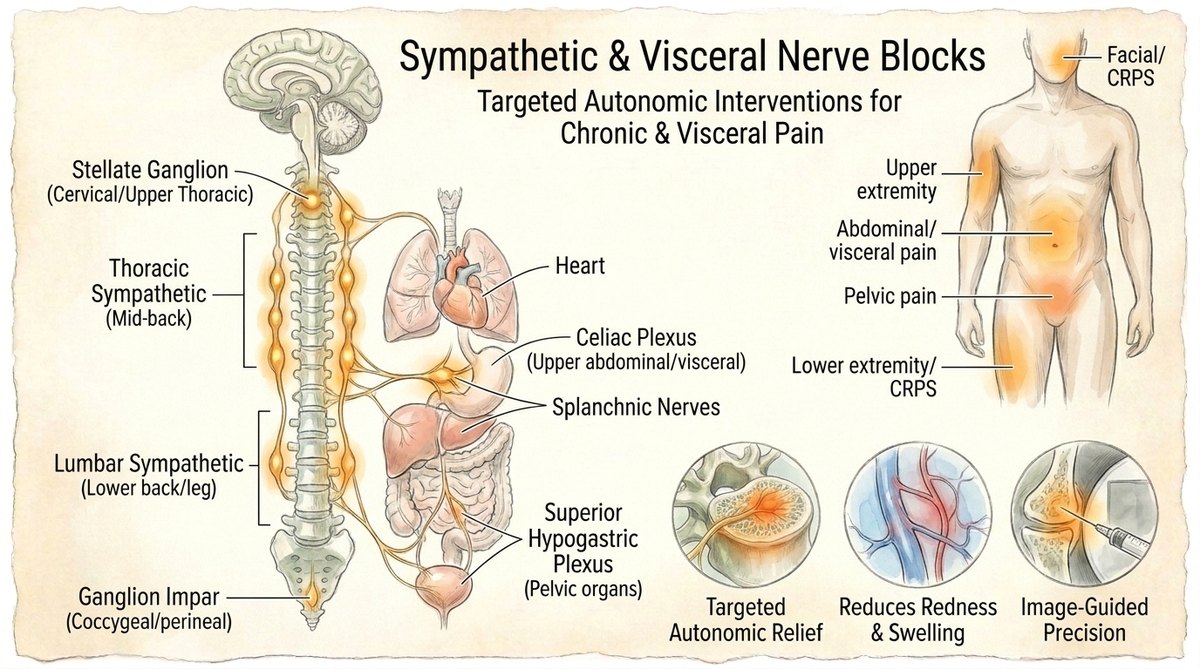
What these blocks target
The sympathetic nervous system — the part that regulates rather than just transmits.
Most pain signals we treat travel through somatic nerves — pathways you can map to a specific body part. Sympathetic and visceral nerve blocks target a different system: the autonomic nerves that regulate blood vessels, organs, and body temperature.
When this system becomes part of a pain problem — as it does in CRPS, cancer pain affecting abdominal organs, chronic pelvic pain, and some post-surgical pain syndromes — standard approaches don't reach it. These blocks do.
They are evaluated individually, not offered as general options. If you have been referred for one of these specifically, or if your pain fits a pattern that suggests this pathway is involved, call us to discuss whether evaluation makes sense.
The five procedures
Same principle, different anatomical targets.
Upper abdominal
Celiac Plexus Block
The celiac plexus is a network of nerve fibers that transmits pain from the upper abdominal organs — pancreas, liver, gallbladder, stomach, and small bowel. Blocking it is most commonly used for pancreatic cancer pain and chronic pancreatitis, where oral opioids produce inadequate relief or significant side effects at effective doses.
Most used for
Pancreatic cancer pain · Chronic pancreatitis
Approach
Image-guided injection at the celiac axis, behind the stomach
Duration
Variable; often weeks to months · Neurolytic version for cancer pain may be longer-lasting
Cervical sympathetic chain
Stellate Ganglion Block
The stellate ganglion is a sympathetic nerve cluster at the base of the neck that serves the head, neck, arm, and upper chest. Blocking it is used for CRPS or sympathetically maintained pain affecting the upper extremity, certain vascular pain conditions, and, with growing evidence, some post-traumatic stress and hot-flash-related applications.
Most used for
CRPS / RSD of the arm · Sympathetically maintained pain · Certain vascular pain
Approach
Ultrasound or fluoroscopy-guided injection at the C6 level, anterior neck
Signs it worked
Horner's syndrome — temporary drooping eyelid and warmth in the arm — confirms sympathetic block
Lumbar sympathetic chain
Lumbar Sympathetic Block
The lumbar sympathetic chain runs along the front of the lumbar vertebrae and governs sympathetic activity in the lower extremities. Blocking it is used for CRPS or sympathetically maintained pain affecting the leg or foot, and for vascular pain conditions including peripheral arterial disease.
Most used for
CRPS / RSD of the leg or foot · Peripheral arterial disease pain · Hyperhidrosis
Approach
Fluoroscopy-guided injection at the anterolateral surface of L2–L4
Signs it worked
Warmth and increased blood flow to the leg confirms sympathetic interruption
Coccygeal / perineal
Ganglion Impar Injection
The ganglion impar is a single sympathetic ganglion at the front of the coccyx (tailbone). It transmits pain from the perineum, rectum, distal urethra, and vagina. Blocking it is used for refractory coccydynia, perineal pain syndromes, and cancer pain in the pelvic floor area — conditions that are often undertreated because the pain pattern is unfamiliar.
Most used for
Coccydynia · Perineal pain · Cancer pain at the pelvic floor
Approach
Fluoroscopy-guided injection through or adjacent to the sacrococcygeal junction
Why it matters
Many patients with perineal pain have never been offered a targeted approach — this block reaches a source standard injections don't
Pelvic sympathetic
Superior & Inferior Hypogastric Plexus Block
The hypogastric plexus carries sympathetic pain signals from the bladder, prostate, uterus, ovaries, descending colon, and rectum. Blocking it addresses chronic pelvic pain of visceral origin — including pain from gynecological cancers, endometriosis, interstitial cystitis, and post-surgical pelvic pain — when conventional approaches haven't adequately helped.
Most used for
Chronic pelvic pain · Gynecological or colorectal cancer pain · Interstitial cystitis
Approach
Fluoroscopy-guided injection anterior to L5–S1 (superior) or at S3–S4 (inferior)
Note
Both superior and inferior levels may be used depending on the pain distribution
Common questions
What patients ask about sympathetic blocks
Pain that hasn't responded to conventional treatment sometimes has a different pathway behind it.
Call and describe what you've tried and what hasn't worked. If a sympathetic or visceral block is worth evaluating, we'll say so plainly.
Sympathetic and visceral nerve blocks carry risks including bleeding, infection, nerve injury, vascular injury, and temporary blood pressure changes. Risks vary by the specific procedure and anatomical site. This page is general education, not medical advice. You are entitled to a clear explanation of risks, alternatives, and the option to seek a second opinion.