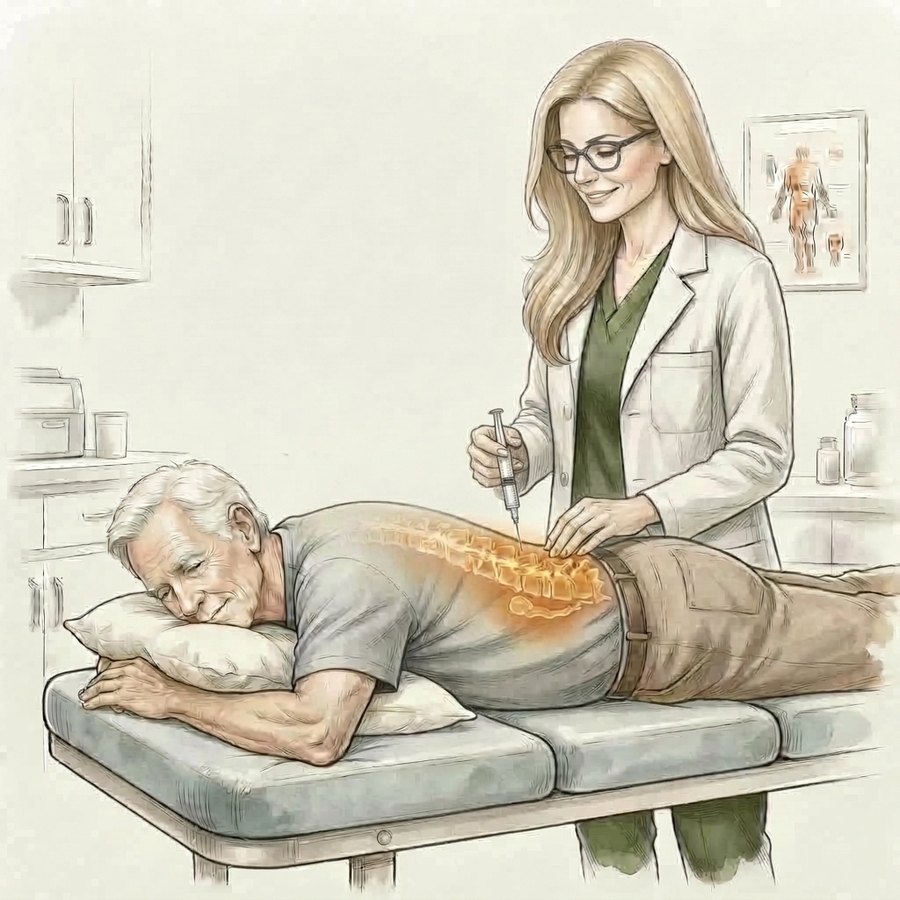
Before you consider one
Most patients who come to us don't need an injection.
We'd rather talk you out of one than into one.
Injections are the most visible thing a pain clinic does, and the most over-offered. For a large share of musculoskeletal pain, movement, time, and the right medication produce comparable results at twelve months with fewer risks and lower cost.
That is not modesty — it's the reason we can be trusted when we do recommend one. An injection earns its place when three things are true at the same time:
There's a specific target
Your history, exam, and imaging point to one structure — not a general region of discomfort
Conservative care wasn't enough
Time, movement, and medication have been genuinely tried — not just mentioned
It changes what happens next
Either it relieves your pain, or it tells us something that redirects the plan. Both are useful; neither is automatic
If you come in and none of those are true yet, we will say so — and we will tell you what we think should happen first instead.
What we offer
Injections, grouped by what they target.
A nerve block is a type of injection — the difference is the target, not the technique. All of these are placed using image guidance, so the medication reaches the intended structure rather than the general area.
Spine
Neck, mid-back, low back, and the joint linking spine to pelvisEpidural Steroid Injection (ESI)
Facet Joint Injection
Medial Branch Block Diagnostic
Sacroiliac (SI) Joint Injection
Joint & Bursa
Knee, hip, shoulder, and the fluid-filled sacs that cushion themLarge Joint Injection
Bursa Injection
Nerve Blocks
Aimed at one specific nerve carrying the pain signalOccipital Nerve Block
Genicular Nerve Block Diagnostic
Peripheral Nerve Block
Sympathetic Nerve Block
Muscle
For pain generated by muscle rather than joint or nerveTrigger Point Injection
Don't see yours listed?
This page covers what we perform most often, not everything that exists. If you were told elsewhere that you need a specific injection, call and we can tell you whether it's something we do — and whether we think you need it.
Discography: We perform diagnostic discography, though infrequently — it is used selectively when other imaging has not clarified the pain source. If you have been referred for this, call us to discuss whether it applies to your situation.
Who performs it
You'll know who is doing your procedure before you arrive.
Two providers perform injections at CPMC Care. Both are experienced, and neither is a stand-in for the other.
Pain Medicine Specialist
James Lin, MD
- Board-Certified in Pain Medicine
- Image-guided spine procedures
- Diagnostic blocks and radiofrequency ablation
- MD, Rush University · MS Neuroscience, Northwestern
Physician Assistant · PA-C
Beth Brown, PA-C
- 15+ years in pain management and rehabilitation
- Ultrasound-guided injections
- Trigger point and joint injections
- MS, Rosalind Franklin University
Which provider you see depends on the procedure and on scheduling — and in most cases you will see the same person at each visit. That continuity matters more than most patients expect: the provider who examined you knows what your pain looked like before, and can tell whether something has actually changed.
What actually happens
Most of the fear is about not knowing.
So here is the whole thing, start to finish. Details vary by procedure, and we will walk you through your specific one beforehand — but this is the shape of it.
The week before
We tell you what to pause and who should drive
If you take a blood thinner, we will give you specific instructions — do not stop anything on your own. If you have diabetes, we will talk about blood sugar, since steroids can raise it temporarily. For most spine and nerve procedures, you'll need someone to drive you home.
Arrival
Consent, questions, and no rushing
We confirm what we're doing and why, review the risks in plain language, and answer whatever you want to ask. If you change your mind at this point, that is entirely allowed — nothing proceeds until you're ready.
In the room · usually 5–15 minutes
Positioning, numbing, then the injection itself
You'll be positioned for access to the target. The skin is cleaned and numbed with a small injection of local anesthetic — this is the part most people feel. Using image guidance, the needle is then placed at the target and the medication delivered. Most patients describe pressure rather than sharp pain, and most are surprised how quickly it's over.
Immediately after
A short observation period
You'll rest briefly while we make sure you're comfortable and stable. The numbing medication may make the area feel heavy, warm, or oddly absent for a few hours — that is expected, and it is also information: what it numbs tells us something.
That evening
Some soreness is normal
As the local anesthetic wears off, the original pain often returns and the injection site may ache. Ice helps. Take it easy, but you do not need bed rest — gentle normal movement is better than lying still.
Next 2 to 7 days
Steroid effects build gradually
If a steroid was used, the benefit develops over several days rather than immediately. Judging the result on day one is the most common mistake patients make. We will tell you when to start paying attention.
Follow-up
We ask what changed — and act on the answer
Whether the injection helped a lot, a little, or not at all, each of those results means something different about what's driving your pain. A clear "no change" is not a failure; it rules out a target and redirects the plan.
Honest limits
What injections can't do.
You should hear this before the procedure, not after it.
They don't repair structure
An injection can calm inflammation and quiet a pain signal. It does not regrow cartilage, reverse arthritis, or undo a disc change.
Relief is often temporary
For many patients the value is the window it opens — a period with less pain, in which movement and rehabilitation can finally do their work.
Steroids can't be repeated indefinitely
Repeated steroid exposure carries real risks, so injections are spaced and limited. More is not safer, and it is usually not more effective.
A third attempt rarely rescues two failures
If two well-placed injections haven't helped, repeating is not the answer. That result is information — it should change the plan, not restart it.
They can't outrun a sensitized nervous system
When pain has persisted for years, the nervous system itself may be amplifying the signal. Injecting the original site won't reach that — a different approach is needed.
They don't work alone
The patients who do best pair the injection with movement, strengthening, and sleep — not with rest and waiting.
Before your appointment
Tell us these things — all of them matter.
Please let us know if you:
Some of these change the timing of a procedure, and some change whether it should happen at all. None of them are a reason to be embarrassed, and all of them are easier to handle before the day than during it.
- Take a blood thinner or antiplatelet medication
- Have diabetes or difficulty controlling blood sugar
- Have an active infection or fever
- Have had a reaction to contrast dye, steroids, or local anesthetic
- Are pregnant or may be pregnant
- Have a pacemaker or implanted device
- Take medication for immune suppression
- Have had a recent vaccination
Please don't stop any prescribed medication on your own before a procedure. Call us at (805) 557-7050 and we'll tell you exactly what to do.
Common questions
What patients ask about injections
Not sure whether an injection is right for you?
That's the correct starting position. Call and we'll evaluate what's driving your pain first — the recommendation follows from that, not the other way around.
All injection procedures carry some degree of risk, including bleeding, infection, nerve irritation, and reactions to medication — and no procedure works for everyone. This page is general education, not medical advice for your situation. Before proceeding you are entitled to a clear explanation of the risks, the alternatives, and what happens if you choose to do nothing, and you are always welcome to seek a second opinion.