Is this your back pain?
Vertebrogenic pain has a recognizable pattern.
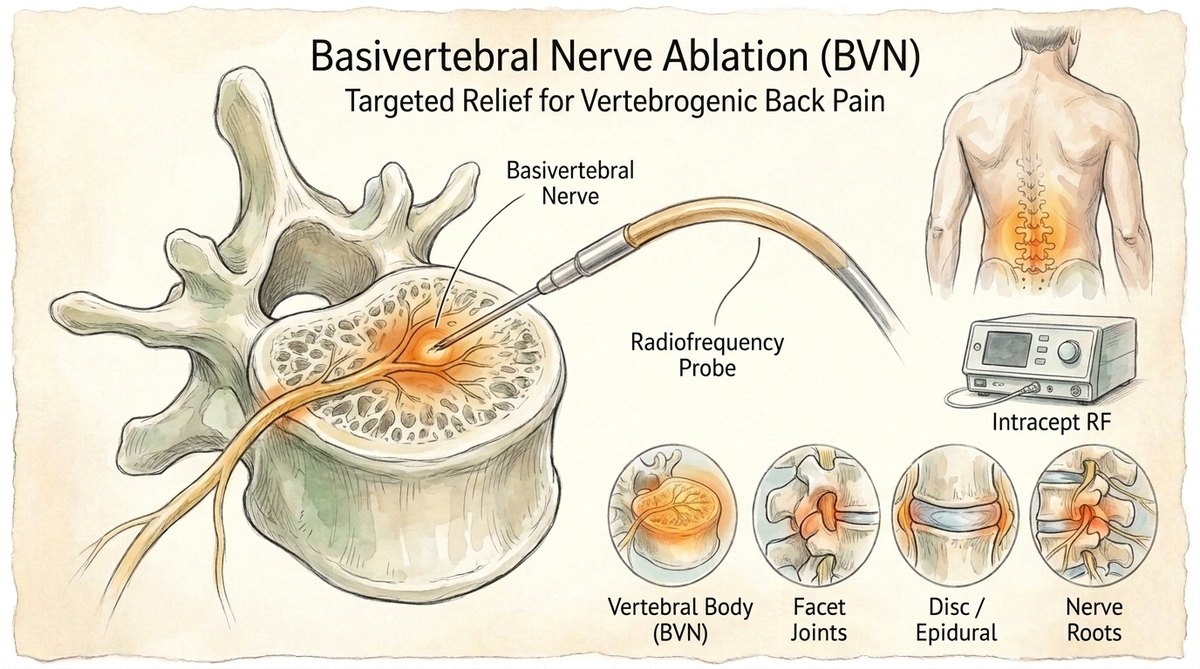
The vertebral endplate is the surface where a disc meets the bone above and below it. When those endplates are damaged and inflamed, the basivertebral nerve inside the vertebral body carries that signal to the brain. The resulting pain behaves differently from disc pain or nerve pain — which is what makes it identifiable.
Deep, central, in the middle of the low back
Often described as aching or burning, and hard to point to with one finger — it feels like it's coming from inside
Worse with sitting
Long drives, desk work, and flights are often the worst part of the day
Worse bending forward
Loading the front of the spine — bending, lifting, leaning over a sink — reproduces it
It has lasted six months or more
And has not resolved with physical therapy, medication, or time
What it usually is not
- Pain shooting down the leg with numbness or tingling — that points toward a compressed nerve root, not the endplate
- Pain clearly worse standing and extending backward, better sitting — that pattern points toward the facet joints
- Pain low and off to one side over the buttock — more typical of the sacroiliac joint
These distinctions matter because each points to a different treatment. Reading a list is not a diagnosis, but it tells you what to ask about.
Who qualifies
Three criteria — and one of them is visible on a scan.
Most back pain diagnoses rely on the story and the examination. Vertebrogenic pain is unusual in that it has an objective imaging marker, which means candidacy is less a matter of opinion than usual.
Criterion One
The pain pattern fits
Deep, midline, chronic low back pain that worsens with sitting and forward bending, without radiating leg symptoms.
Criterion Two
Modic changes on MRI
Type 1 or Type 2 endplate changes at the relevant levels — inflammation or fatty change in the bone marrow next to the endplate. This is the objective marker.
Criterion Three
Six months of conservative care
Physical therapy, medication, and time have been genuinely tried and have not resolved the pain.
"My MRI report mentions Modic changes. Does that mean I need this?"
Not on its own. Plenty of people have endplate changes on imaging and little or no back pain, just as plenty of people have disc bulges and feel fine. An MRI finding only matters when it lines up with what you actually feel and where.
If your report mentions Modic changes and your pain matches the pattern above, that's worth an appointment. If your report mentions them and your pain is shooting down your leg, the endplates probably aren't your problem — and we'd tell you so rather than treat them.
Experience & technology
The experience matters more than the equipment.
James Lin, MD has been performing basivertebral nerve ablation for several years.
BVNA is still described as a newer procedure, and in many places it is. That is not the case here — Dr. Lin has been treating vertebrogenic pain with this approach since well before it became widely available in the region, across more than one generation of technology.
In 2026 he began performing the procedure using ViaVerte, an FDA-cleared basivertebral nerve ablation system distributed by Medtronic, which uses a physician-steerable mechanism to reach the nerve and is implant-free. As of 2026, CPMC Care is the only practice in Thousand Oaks offering this system.
We mention the system because patients ask about it. But a newer probe does not substitute for judgment about who should be treated in the first place — which is where most of the difference in outcomes actually comes from.
Years of experience
Performing BVNA across multiple technology generations
Saint Charles Surgical Center
Same-day outpatient, no hospital stay
Implant-free
Nothing is left in your spine afterward
What happens on the day
Inside the bone, but not surgery in the way you're picturing.
The basivertebral nerve sits inside the vertebral body, so reaching it means making a small channel through the bone. There is no incision, no fusion, and nothing left behind.
Beforehand
Authorization, instructions, and a driver
Plans that require prior authorization need your MRI findings and documented conservative care, so we handle that before scheduling. You'll get specific instructions about blood thinners and eating, and you'll need someone to drive you home.
At the surgical center
Sedation and positioning
Unlike most of our office injections, BVNA is performed at Saint Charles Surgical Center with sedation. You lie on your front, and the area is numbed in addition to the sedation.
The procedure · about an hour
Reaching the nerve, then treating it
Using X-ray guidance, a channel is created through the side of the vertebra to reach the basivertebral nerve near the center of the vertebral body. A probe delivers radiofrequency energy to interrupt the nerve, with temperature monitored throughout. The probe is then removed. Usually more than one vertebral level is treated in the same session.
Same day
You go home
After a recovery period you're discharged the same day. Expect soreness in the low back for several days — walking and light normal activity are encouraged, heavy lifting and strenuous exercise are not, for a period we'll specify.
Weeks to months
Improvement builds gradually
This is not a procedure that delivers relief the next morning. Benefit typically develops over weeks, and continues improving for some patients over several months. We follow up along the way rather than leaving you to wonder.
What the evidence shows
Better studied than most back pain procedures.
Basivertebral nerve ablation has been examined in randomized controlled trials — including sham-controlled work, which is uncommon in interventional pain — as well as prospective cohort studies with long-term follow-up. Pooled analyses of those trials have reported that improvements in pain and function were sustained in treated patients out to five years.
The American Society of Pain and Neuroscience has published best-practice guidelines on diagnosing and treating vertebrogenic pain with BVNA, which is part of why insurers now cover it under defined criteria rather than treating it as experimental.
What that evidence does not say is that it works for everyone. Published results describe groups of carefully selected patients who met specific criteria. The reason we are strict about candidacy is that the results only hold up when the selection does.
We deliberately don't quote manufacturer success percentages on this page. Those figures come with conditions attached, and we would rather tell you what we've seen and what the peer-reviewed literature supports than hand you a number.
When it's not the answer
This is a narrow treatment for a specific diagnosis.
Not for radiating leg pain
Sciatica and nerve root compression are a different problem with different treatments. See nerve pain & sciatica.
Not for facet-pattern pain
If your pain is worse standing and extending rather than sitting, facet RFA is likely the more appropriate target.
Not without qualifying MRI findings
No Modic changes at the relevant levels means no clear target — and no reason to expect benefit.
Certain bone conditions complicate it
Significant metabolic bone disease, active infection, or fracture at the treatment levels may make the procedure inadvisable. We assess this before scheduling.
It doesn't repair the endplate
As with all ablation, we interrupt a signal rather than restore a structure. The endplate changes remain on imaging.
Some patients don't respond
Even with textbook candidacy, a minority see little benefit. We can't identify them in advance, and you should hear that beforehand.
Common questions
What patients ask about BVNA
Bring your MRI. We'll tell you honestly whether this applies to you.
If your pain is deep, central, and worse when you sit — and your imaging shows endplate changes — this is worth a conversation. If it isn't, we'll say so and point you toward what does fit.
Basivertebral nerve ablation carries risks including bleeding, infection, nerve injury, vertebral fracture, and reactions to sedation — and results vary between patients. This page is general education, not medical advice for your situation. Product names are used to describe the equipment involved and do not imply endorsement. Before proceeding you are entitled to a clear explanation of the risks, the alternatives, and what happens if you choose to do nothing, and you are always welcome to seek a second opinion.