What it actually does
It changes the signal on its way to the brain.
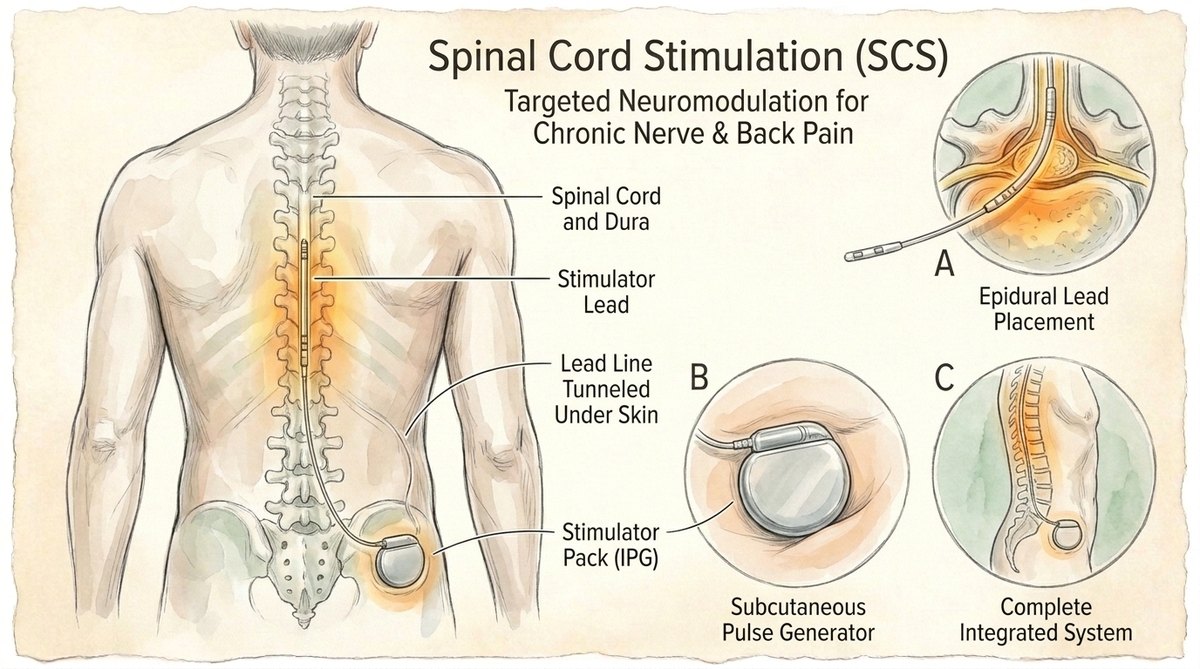
Pain signals travel up the spinal cord before they ever reach the brain. A spinal cord stimulator places thin leads in the epidural space near that pathway and delivers low-level electrical signals that change how those messages are transmitted. The pain generator — a damaged nerve, scar tissue from surgery, a nerve that has become chronically irritated — is still there. What changes is how much of it arrives.
This is why stimulation is used for a specific kind of pain. It works on neuropathic pain — burning, electrical, radiating pain coming from the nerves themselves — far better than on mechanical pain coming from a joint or muscle. Matching the right pain type to the right treatment is most of the work.
Related technology, peripheral nerve stimulation, applies the same principle to a single nerve outside the spine rather than the spinal cord itself. Which approach fits depends on where your pain originates.
The trial comes first
Nobody gets an implant they haven't already tested.
The part that makes this different
You wear it through an ordinary week of your life — then decide.
Thin temporary leads are placed through a needle in the office, with no incision. They connect to a small external device you wear on a belt. Then you go home and live normally: sleep, work, walk the dog, sit through a long drive, do the thing your pain has been stopping you from doing.
After roughly five to seven days you come back, the leads are removed in the office, and we look at what actually happened — not at what you hoped would happen.
If it didn't help enough, we stop there. Nothing was implanted, nothing was altered, and you have a real answer instead of a maybe. That is not a failed trial. That is the trial doing exactly what it exists to do.
5–7 days
Long enough to test real life, short enough to be manageable
No incision
Leads placed through a needle, removed the same way
At home
Not in a clinic — your own bed, your own commute, your own stairs
Fully reversible
Say no afterward and nothing has been changed about you
Stage One
The Trial
Stage Two — only if the trial worked
The Implant
Who it's for
Nerve pain that has outlasted everything else.
Stimulation is not an early option, and it shouldn't be. It is considered when conservative care, medication, and targeted injections have been genuinely tried and haven't produced lasting relief — and when the pain is the type that responds.
Pain continuing after spine surgery
Sometimes called post-laminectomy syndrome — the surgery was done, the imaging looks acceptable, and the pain stayed
Radiating leg or arm pain
Persistent nerve pain that injections and time have not resolved
Complex Regional Pain Syndrome (CRPS)
Burning pain with skin, temperature, or swelling changes — one of the conditions stimulation was developed for
Painful diabetic neuropathy
Burning, electrical foot and leg pain that medication has not adequately controlled
What it's generally not for
- Mechanical back pain that improves with rest and worsens with specific movements — that usually points toward the facet joints or endplates
- Arthritis pain in a single joint — other options come first
- Pain that hasn't yet had a thorough conservative trial — stimulation is a late-line treatment by design
- Situations where an untreated structural problem needs surgical attention instead
Many patients have more than one kind of pain at once. Part of the evaluation is separating which pain is which — because stimulation may help one of them and do nothing for the other.
The full timeline
From first appointment to programd device.
This is a longer process than an injection, and it involves more people. Knowing the shape of it up front makes each step less unsettling.
Evaluation
Deciding whether this is even the right conversation
Full history, examination, imaging review, and an honest assessment of what's been tried. If there's a less invasive option that hasn't been properly explored, we'll say so — stimulation is not a shortcut past that.
Psychological evaluation
A standard step, and not what patients fear it is
Required by nearly every insurer and genuinely useful. It is not an assessment of whether your pain is real. It looks for things that are known to affect outcomes — untreated depression, expectations that don't match reality, active substance issues — because addressing those first produces better results.
Insurance authorization
Paperwork we handle
For plans that require prior authorization, it is documentation-heavy. Our office assembles it. This stage takes time, and we'd rather tell you that than have you wondering why nothing seems to be happening.
The trial · about a week
Leads placed, then ordinary life
Temporary leads placed in the office through a needle. You go home with the external device and live normally for five to seven days, keeping track of what changes — pain levels, sleep, what you can do that you couldn't before.
The decision point
Leads out, and a real conversation
Removal takes moments. Then we look at the week honestly. Meaningful improvement means moving forward. Modest or no improvement means we stop — and we talk about what else is worth trying.
Implant · if you proceed
Same-day outpatient surgery
Performed at a surgical center with sedation. Permanent leads are placed and a small generator is positioned under the skin. You go home the same day with a driver, with activity restrictions for several weeks while everything heals into place.
Programming · ongoing
Tuning it to you
The device is adjusted over subsequent visits to find the settings that work best for your pain. This is normal and expected — the first program is rarely the final one.
Living with one
The questions people are too self-conscious to ask.
Can people see it?
The generator sits under the skin and is not visible through clothing. Some people can feel a slight firmness at the site. There is no external wire once healed.
Does it need charging?
Depends on the system. Some are rechargeable with a wireless charger used periodically; others are non-rechargeable and eventually need replacement. We discuss which fits your life before choosing.
Airports and security?
You'll carry an identification card for your device. Notify security rather than walking through unannounced. This is routine and handled thousands of times a day.
Can I still have an MRI?
Many current systems are MRI-conditional, meaning scans can be performed under specific conditions. This varies by device and is part of the selection conversation — tell any future provider that you have one.
Do I control it?
Yes. You have a handheld controller or phone app to turn it on and off and adjust within settings we establish together. Many people vary it by activity or time of day.
Does it last forever?
Leads and generators have finite lifespans, and generator replacement is a smaller procedure than the original implant. Some patients eventually choose removal. Neither outcome is a failure.
Related implantable therapy
Intrathecal Pain Pump
For patients with severe chronic pain — particularly cancer pain, failed back surgery syndrome, or spasticity — where systemic medication at effective doses produces unacceptable side effects, an intrathecal pump delivers medication directly into the fluid surrounding the spinal cord. A much smaller dose reaches the target, with significantly fewer systemic effects.
How it differs from SCS
SCS modifies the pain signal electrically. An intrathecal pump delivers medication chemically. They are used for different pain types — SCS primarily for neuropathic pain, intrathecal pumps more often for severe nociceptive or mixed pain where oral opioids are inadequate.
What the procedure involves
A small catheter is placed in the intrathecal space and connected to a programmable pump implanted under the skin. The pump is refilled periodically in-office. A trial is performed before implant — the same principle as SCS candidacy assessment.
Intrathecal pump candidacy is evaluated case by case. Read more about intrathecal pain pumps →
Honest limits
What a stimulator will not do.
It doesn't cure anything
The nerve damage, the scar tissue, the underlying condition — all still there. Stimulation modifies the signal, and that's the entire mechanism.
It rarely eliminates pain
The realistic goal is substantial reduction and better function. A patient expecting zero pain will be disappointed by an outcome another patient would call life-changing.
Benefit can fade over time
Some patients find relief diminishes after a period. Reprogramming often helps. Sometimes it doesn't, and that possibility belongs in the decision.
A successful trial isn't a guarantee
The trial is the best predictor available, and it's a good one — but it is not a promise. Long-term results vary.
It's still surgery with real risks
Infection, bleeding, lead migration, hardware problems, and the need for revision are all possible. Your consent conversation will cover these specifically.
It doesn't replace the rest of the work
Movement, sleep, and conditioning still matter. The patients who do best use the relief to become more active, not less.
Common questions
What patients ask about stimulation
If you've been told there's nothing left to try, this is worth a conversation.
Stimulation exists for people who have already been through the other options. And because the trial comes first, finding out whether it works for you does not require committing to anything.
Spinal cord stimulation is a surgical procedure carrying risks including infection, bleeding, nerve injury, lead migration, hardware malfunction, and the possible need for revision or removal — and results vary between patients. This page is general education, not medical advice for your situation. Before proceeding you are entitled to a clear explanation of the risks, the alternatives, and what happens if you choose to do nothing, and you are always welcome to seek a second opinion.