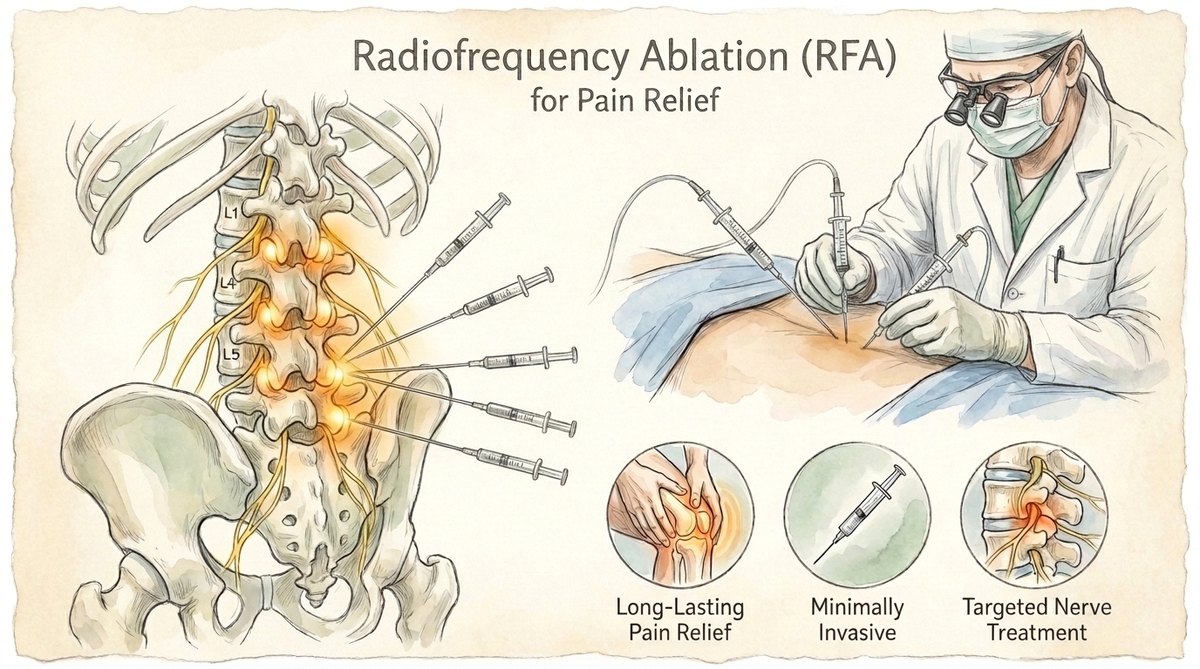
What RFA actually does
It interrupts a signal. It doesn't fix a structure.
Pain from a joint travels along small sensory nerves to the brain. Radiofrequency ablation uses heat delivered through a needle to interrupt those specific nerves, so the signal stops arriving. The arthritis in the joint is still there. What changes is whether you feel it.
That distinction is worth sitting with, because it explains both the appeal and the limits of the procedure. RFA can give someone their sleep, their walk, or their work back for a year or more without surgery, hardware, or daily medication. It cannot regrow cartilage or reverse degeneration, and it was never meant to.
You may also hear this called radiofrequency neurotomy, rhizotomy, or nerve ablation. They refer to the same family of procedure.
The two-step rule
The block isn't a formality. It's the whole decision.
Ablation is only as good as the target. So before we treat a nerve, we test it — by numbing it temporarily and seeing what happens to your pain.
Step One
Diagnostic Block
A small amount of local anesthetic is placed at the specific nerves we would ablate. It wears off within hours — that's intentional.
- Takes only a few minutes
- You track your pain for the rest of the day
- Often repeated once to confirm the result
Step Two — only if step one worked
Radiofrequency Ablation
If numbing those nerves clearly relieved your pain, we treat them with radiofrequency heat for a much longer effect.
- 20–40 minutes depending on levels treated
- Same-day outpatient, no incision
- Benefit typically develops over 2–4 weeks
If the block doesn't help, we stop — and that's a good outcome.
It doesn't feel like one. After waiting weeks for an appointment and going through a procedure, being told "this isn't your answer" is deflating.
But consider the alternative: an ablation on nerves that were never the problem. You'd have gone through a longer procedure, waited a month for relief that was never coming, and still not known where your pain was actually from. A negative block costs you an afternoon and saves you all of that.
It also redirects the search. If the facet joints aren't the source, that's real information about what to examine next.
Where it's used
Four targets, four different conversations.
RFA isn't one procedure. Where the nerves are, and what pattern of pain points to them, differs by site.
Lumbar Facet Joints
Cervical Facet Joints
Sacroiliac (SI) Joint
Knee
What happens on the day
Longer than a block, shorter than you're imagining.
Before you come in
Blood thinners, blood sugar, and a driver
We give you specific instructions about any blood-thinning medication — never stop one on your own. You'll need someone to drive you home. Eat lightly beforehand unless we've told you otherwise.
In the room · 20–40 minutes
Positioning, numbing, testing, then treating
You lie on your front or back depending on the target. The skin and deeper tissue are numbed. Using image guidance, needles are positioned at the nerves, and a brief electrical test confirms placement — you may feel a tingle or a muscle twitch, which is expected and tells us we're in the right place. Then the radiofrequency current is applied, usually for a minute or so per site.
The first few days
It often feels worse before it feels better
Soreness at the treated sites is common and can last one to two weeks. Some patients get a temporary flare of their usual pain. This is the single most misunderstood part of RFA — patients assume it failed. Ice, gentle movement, and patience are the right response.
2 to 4 weeks
The real result arrives
As the treated nerves stop transmitting and the procedural soreness settles, the actual benefit becomes clear. Judging RFA before this point tells you almost nothing.
Follow-up
We measure it, and we plan the next window
We check what changed — pain, sleep, what you can do again. If it worked well, this is also the moment to use the window: strengthening done during a low-pain period is what makes the next year better, not just this one.
How long it lasts
Six months to two years — and then the nerves grow back.
That last part surprises people, so we say it early. The treated nerves regenerate over time. This is why RFA is described as long-lasting rather than permanent, and it's also why the procedure is repeatable — when the same pain pattern returns, we can generally treat again, with results that tend to hold up about as well as the first time.
The range is wide because patients are different. Some get eight months, some get two years, and a minority get little benefit despite a positive block. We won't tell you a number we can't stand behind — but we will tell you what we've seen in situations like yours.
What you do during the window matters more than most patients are told. A year of reduced pain spent building strength and mobility puts you in a different position when the nerves return than a year spent resting.
When it's not the answer
RFA is specific. That's its strength and its boundary.
Not for radiating nerve pain
Shooting pain down the leg or arm usually comes from a compressed nerve root, not a facet joint. RFA of the medial branches won't reach it. That's a different problem.
Not without a positive block
No diagnostic confirmation, no ablation. This isn't insurance bureaucracy — it's the difference between treating a target and guessing at one.
It doesn't treat the arthritis
The joint changes remain. RFA removes the alarm, not the cause — which is exactly why strengthening during the relief window matters.
Limited help for widespread pain
When pain is diffuse rather than localized, or the nervous system has become broadly sensitized, targeting one set of nerves rarely resolves it. A different approach applies.
Not a substitute for surgery when surgery is indicated
If there's progressive weakness, instability, or a structural problem that needs fixing, RFA is not the right tool and we'll say so.
Some patients simply don't respond
Even with a clearly positive block, a minority get little benefit. We don't know in advance who. You deserve to hear that before, not after.
Common questions
What patients ask about RFA
Wondering whether your pain is coming from a facet joint?
That's the question an evaluation answers. Call and we'll examine you, review your imaging in context, and tell you whether a diagnostic block is the right next step — or whether something else should come first.
Radiofrequency ablation carries risks including bleeding, infection, nerve irritation, temporary increased pain, and altered sensation over the treated area — and results vary between patients. This page is general education, not medical advice for your situation. Before proceeding you are entitled to a clear explanation of the risks, the alternatives, and what happens if you choose to do nothing, and you are always welcome to seek a second opinion.