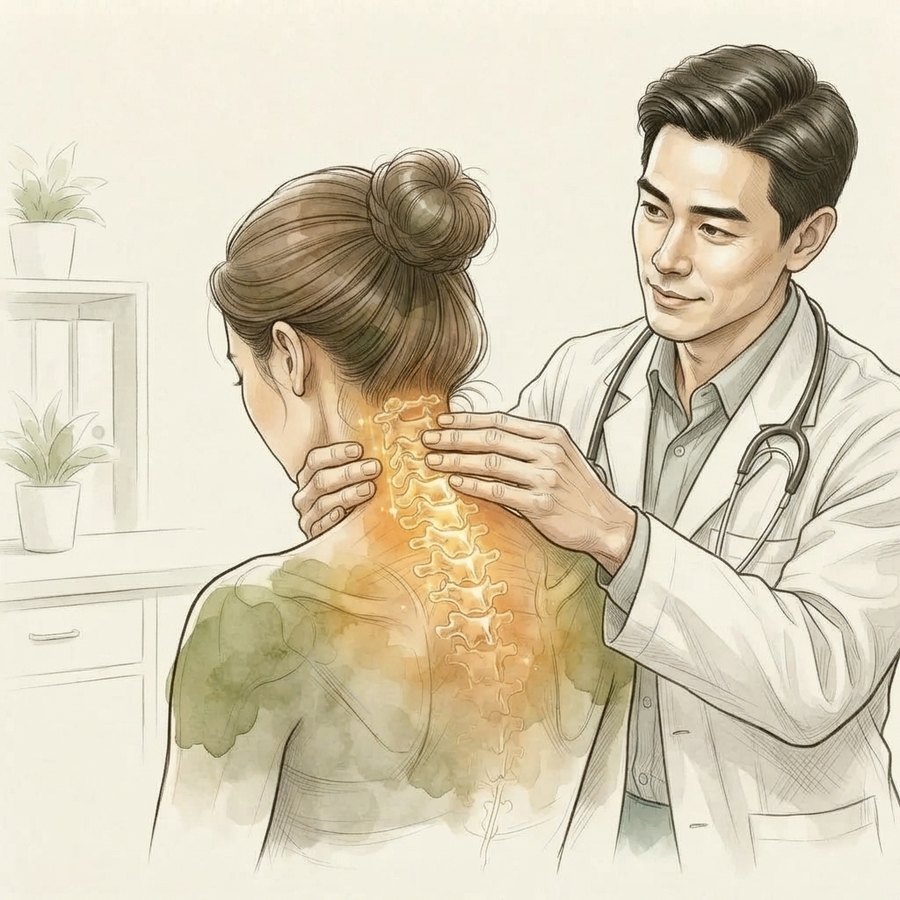
Neck pain that won't go away is telling you something.
Neck pain can affect how you sleep, drive, work, and move through your day. Understanding what's behind it is the first step toward the right approach.
Neck pain can affect how you sleep, drive, work, and move through your day. Understanding what's behind it is the first step toward the right approach.
Is this your neck pain?
Neck pain presents differently for everyone. These are some of the patterns we see most often.
Stiff every morning
Waking up unable to turn your head comfortably, easing slowly through the day
Pain after desk work
Tightness and aching that builds through the workday, worse by evening
Headaches from the neck
Headaches that start at the base of the skull and spread forward
Pain into the arm
Shooting, tingling, or numbness traveling from the neck into the shoulder, arm, or hand
The cervical spine has 7 vertebrae (C1–C7) with discs between each one and nerve roots branching out to the shoulders, arms, and hands. Compression or irritation at any level can produce pain locally — or far from its source.
What could be causing it
The same symptom — neck stiffness, for example — can have very different causes. Identifying the right one changes the treatment completely.
Herniated or degenerated discs in the neck can irritate nearby nerves, causing local pain or symptoms that radiate into the arm or hand.
Small joints between each vertebra can develop arthritis, causing neck stiffness and pain that often worsens with movement or looking up.
A compressed nerve root produces pain, tingling, or weakness that travels from the neck into the shoulder, arm, or fingers — often on one side.
Narrowing of the spinal canal in the neck can compress the spinal cord or nerve roots, producing symptoms in both the neck and limbs.
Sudden acceleration-deceleration injury stretches ligaments, muscles, and joints. Symptoms can persist long after the original event.
In some patients, the nervous system becomes sensitized and amplifies pain signals beyond the original cause — requiring a different treatment approach.
Cervical
spine
Shoulder
& upper arm
Elbow
& forearm
Hand
& fingers
When a cervical nerve is compressed or irritated, pain doesn't always stay in the neck — it can travel along the nerve pathway into the arm or hand.
Could this be nerve pain? → ExploreHow we evaluate it
Not every neck pain is the same. We take time to understand yours before recommending anything.
What does your pain feel like? When did it start? What makes it better or worse? What has already been tried?
Neck range of motion, muscle strength, sensation, reflexes — physical findings that imaging alone doesn't capture.
Your MRI, X-ray, or CT reviewed in the context of your symptoms — not in isolation.
Identify what's most likely driving your pain — and what that means for your options.
A treatment plan built around your specific situation, explained clearly, starting where it makes sense to start.
What treatment may look like
We begin with the most appropriate level of intervention — conservative first, targeted when warranted.
Understanding what's driving your neck pain — and why it persists — often changes how you relate to it.
Targeted exercises to restore mobility, reduce strain, and build resilience in the cervical spine.
Appropriate medications — anti-inflammatories, neuropathic agents, muscle relaxants — balanced for your situation.
Epidural steroid injections, facet joint injections, and nerve blocks — used when clinically indicated.
For confirmed facet joint pain, RFA can provide longer-lasting relief by interrupting specific pain signals.
Common questions
Thousand Oaks, CA
Board-certified in Pain Medicine. Neuroscience-trained. Conservative approach first.
(805) 557-7050Mon–Fri · 8:00 AM – 5:30 PM
558 St. Charles Drive, Suite 110, Thousand Oaks
Related condition
Back & Spine Pain
Neck and back pain often share causes and treatment approaches. If you have pain in both areas, a comprehensive spine evaluation may be most useful.
Learn about back pain →
Treatments for this condition