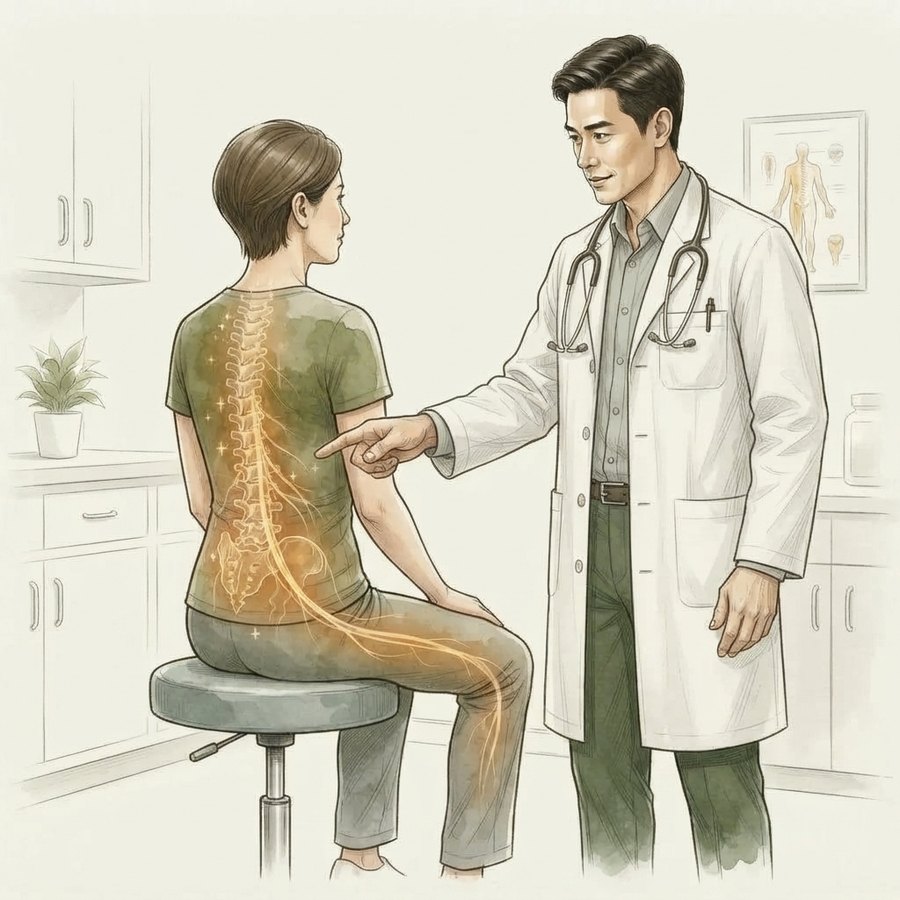
Pain that shoots, burns, or travels down your leg deserves a real answer.
Nerve pain is one of the most disruptive — and most misunderstood — types of pain. Understanding what's driving it is the first step toward effective treatment.
Nerve pain is one of the most disruptive — and most misunderstood — types of pain. Understanding what's driving it is the first step toward effective treatment.
Is this your pain?
It often has a distinct quality — electric, burning, shooting — and a pattern that follows a nerve pathway. These are the patterns we see most often.
Shooting pain down the leg
Pain that starts in the lower back or buttock and travels down the leg — sometimes reaching the foot
Burning or electric sensation
A burning, stinging, or electric-shock feeling that comes and goes — often worse at night
Numbness or tingling
Pins and needles, or areas of the leg or foot that feel numb or "asleep"
Weakness in the leg
Difficulty lifting the foot, or leg giving way — a sign that motor nerves may be involved
Lower spine (L4–S1)
Nerve roots exit the lumbar spine — compression here is the most common cause of sciatica
Buttock & hip
Pain often first noticed here — deep aching or shooting discomfort in the gluteal area
Back of the thigh
The sciatic nerve runs through the back of the leg — pain may intensify with sitting or bending
Knee & lower leg
Burning, cramping, or weakness below the knee — often misattributed to a leg or knee problem
Foot & toes
Numbness, tingling, or weakness in the foot — the nerve's reach can extend this far
Pain at any point along this pathway may originate in the spine. A specialist evaluation traces the source — not just the symptom.
What could be causing it
Sciatica is the most common form — but nerve pain has many sources. Identifying the right one determines the right treatment.
A disc that bulges or ruptures can press on a lumbar nerve root, sending pain along the sciatic nerve pathway into the buttock and leg.
Narrowing of the spinal canal compresses nerve roots, often causing leg pain that worsens with walking and improves with sitting or bending forward.
The piriformis muscle in the buttock can compress the sciatic nerve directly — producing symptoms similar to disc-related sciatica but with a different treatment.
Damage to the peripheral nerves themselves — often from diabetes, medications, alcohol, or other systemic causes — producing burning, tingling, and numbness.
Nerve pain that persists after a shingles outbreak — often severe burning along the path of the affected nerve, sometimes lasting months or years.
In some patients, the nervous system becomes amplified — producing or magnifying nerve pain signals beyond the original injury or cause.
How we evaluate it
Because nerve pain has many causes, pinpointing the right source is what makes treatment effective. We take time to get it right.
Where does the pain start? Where does it go? What does it feel like — burning, shooting, electric? What makes it better or worse?
Neurological examination — testing sensation, reflexes, and muscle strength to identify which nerve or nerve roots are involved.
MRI or CT imaging reviewed in the context of your clinical findings — not in isolation. What the scan shows must match your symptoms.
Is this spinal? Peripheral? Systemic? The answer changes everything about how we approach treatment.
A treatment plan matched to the actual source of your nerve pain — explained clearly, starting where it makes clinical sense.
What treatment may look like
Treatment depends on the source. We begin conservatively — and escalate only when clinically appropriate.
Understanding why nerves produce pain — and what sensitization means — is often the most underutilized first step.
Targeted exercises to reduce nerve compression, restore mobility, and build tolerance to activity.
Neuropathic agents, anti-inflammatories, and other medications — matched to the type of nerve pain and your specific situation.
Targeted injections to reduce inflammation around compressed nerves — providing relief and enabling rehabilitation.
For carefully selected patients with persistent nerve pain that hasn't responded to other treatments — an advanced option evaluated at CPMC Care.
Common questions
Thousand Oaks, CA
Board-certified in Pain Medicine. Neuroscience-trained. Conservative approach first.
(805) 557-7050Mon–Fri · 8:00 AM – 5:30 PM
558 St. Charles Drive, Suite 110, Thousand Oaks
Related condition
Back & Spine Pain
Sciatica most often originates in the lumbar spine. If you have both back and leg pain, a comprehensive spine evaluation is the right starting point.
Learn about back pain →
Treatments for this condition